
In the amber light of a Kenyan dawn, a traveler watches a lioness move through the tall grass – a moment of pure, wild awe. Yet, within that scene lies a deeper, more interconnected story. For guests of The Wilder Group’s collection of camps, that singular sight is woven into a vast tapestry of survival, prosperity, and ecological healing. This is the evolution of the traditional safari into something far more profound: the regenerative safari.
Forging a powerful partnership with the Maasai Wilderness Conservation Trust (MWCT), The Wilder Group operates on a singular, holistic philosophy: travel must be an undeniable “force for good.” Here, protecting a wildlife corridor is intrinsically linked to building a classroom or funding a medical clinic. The mission spans two of Kenya’s most critical ecosystems: the arid, rugged Samburu wilderness in the north, anchored by Sasaab Lodge, and the iconic Amboseli-Tsavo landscape in the south, home to camps like Entim and Ilkeliani in the Maasai Mara. By serving as the economic engine of sustainable tourism, these camps directly fuel the high-impact conservation and community work of MWCT.
The Wilder Group: Hospitality as a Bridge to Empowerment
The Wilder Group operates with the conviction that luxury hospitality should be a direct conduit for local empowerment.
- Education and Training: Building the Next Generation
At Ilkeliani Camp in the Maasai Mara, a specialized training program empowers Maasai youth from neighboring villages. Over three months, participants gain hands-on experience across all camp departments, building the technical skills and professional foundation for careers in Kenya’s competitive tourism sector.
The commitment to education extends deep into communities. The Satao Foundation and Entim Camp have transformed Molibany Primary School, investing $70,000 to construct four new classrooms, a library, and 200 desks. Furthermore, through guest-driven initiatives like “Pack for a Purpose,” visitors have personally contributed an estimated $40,000 in books and essential equipment, directly impacting over 50 students.
2. Local Empowerment and Holistic Care
In Samburu, 75% of Sasaab’s staff are hired from the local community. The camp’s impact is life-altering, funding essential dental and eye clinics, school lunch programs, and conservation scholarships, ensuring tourism revenue translates into tangible health and well-being for households.
3. Fostering Female Entrepreneurs
Innovation also powers economic independence. A burgeoning project is empowering Maasai women to produce sustainable charcoal briquettes. By teaching this trade, the initiative creates a path to independent income, reducing dependency and fostering a new generation of female entrepreneurs.
Partner Spotlight: Maasai Wilderness Conservation Trust’s 2024 Impact
The latest data from MWCT’s 2024 initiatives shows exactly how tourism revenue converts into measurable, on-the-ground results.
The Protected Landscape
MWCT now safeguards 417,608 acres of community-owned land. A landmark achievement in 2024 was securing the 31,700-acre Kitenden Conservancy, a vital linkage. MWCT actively manages five conservancies – Motikanju, Kanzi, Olpusare, Rombo, and Kitenden – protecting over 70,000 acres of critical wildlife corridors that allow elephants, lions, and other species to migrate safely between national parks.
Wildlife Security: The Local Frontline
MWCT’s security program, over 95% staffed by local Maasai, is its largest initiative. 2024 highlights include:
Force Expansion: Training of 47 new rangers, bringing the total force to 256.
Constant Vigilance: Rangers conducted 2,875 anti-poaching patrols, covering 39,478 kilometers on foot.
The Simba Scouts: This elite unit of Maasai warriors tracks lion prides specifically to prevent human-wildlife conflict, alerting herders to predator locations before losses occur.
Human-Wildlife Coexistence
Living alongside predators is a heavy burden, especially during droughts like that of 2024. MWCT’s “Wildlife Pays” consolation program is critical for fostering tolerance. In 2024, the program disbursed $87,909 to community members for livestock losses. Data reveals hyenas were responsible for the highest percentage of losses (34.94%), followed by lions (22.66%). A revised 2024 agreement increased compensation values by 50%, offering greater support.
Climate Action and Habitat Restoration
Protection requires active healing. In 2024, MWCT restored 2,654 acres of degraded land using traditional water-catching “bunds.” This process was documented for the Justdiggit Regreening App to share knowledge globally, while soil moisture sensors from the Wyss Academy provide real-time success data.
Concurrently, the Chyulu Hills REDD+ Project – a Gold-rated carbon offset initiative -preserves a critical watershed for Mombasa and prevents massive greenhouse gas emissions, channeling carbon revenue back into community and conservation projects.
The Camp Ethos: Daily Operations, Global Standards
The Wilder Group embeds sustainability into every camp operation:
Solar Power: A full transition to renewable energy.
On-site Greenhouses: Growing fresh produce to slash food-mile carbon footprints.
Zero-Plastic Policy: A complete shift from single-use plastics to reusable stainless steel and glass.
The Essential Wildlife: Corridors for Iconic Species
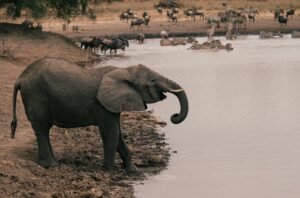
The survival of Africa’s iconic species hinges on these protected corridors. In the north, Sasaab offers viewing of the “Samburu Special Five”: the Grevy’s zebra, reticulated giraffe, Beisa oryx, Somali ostrich, and gerenuk. To the south, MWCT’s Simba Scouts and camera traps meticulously monitor the “Big Three” of the Amboseli-Tsavo corridor: lions, elephants, and cheetahs, ensuring these populations have the space and security to thrive.
Conclusion: A Legacy for Generations
Luca Belpietro, Director of MWCT, speaks of an invitation to “scale this proven model.” The vision shared by The Wilder Group and MWCT demonstrates that nurturing an entire ecosystem is the most powerful way to uplift human lives.
By choosing a regenerative safari, travelers become active participants in this legacy.
As Belpietro notes, this support is an investment in the future, ensuring that “your grandchildren can enjoy this wilderness, cultural, and wildlife Maasai heritage.”
It’s a journey where every moment of awe is also an act of preservation.